Hong Hao2026-09-04 13:08:10Hong Hao on the AI Trade: Why South Korea’s Chip Stocks Unwound Faster Than Any Prior BubbleEconomist Hong Hao used South Korea’s semiconductor selloff to explain what he sees as the mechanics behind the AI trade, its mid-year cooldown, and the speed with which crowded positions can reverse. In his account, the chip rally shared the same core ingredients seen in earlier bubbles: a powerful narrative, expanding leverage, and a market structure that rewards trend followers while pushing contrarian investors to the margins. Hong said the South Korean semiconductor complex went from a peak to roughly half that level in about 40 days, a move he described as a key case study for reading cycles, leverage, and crowd behavior. He argued that standard assumptions taught in traditional finance — full information, fully rational participants, and frictionless trading — do not hold in real markets. He also pointed to a rare period in which gold and equities rose together, saying that such a pattern signals a regime shift in which traditional hedges and correlation-based portfolio construction can break down. The discussion extended to the failure of the 60/40 stock-bond model during the 2022 inflation shock, the role of leveraged ETFs in amplifying gains and losses, and the illusion of diversification when dozens of positions share the same risk exposure. Even so, Hong did not frame bubbles as purely destructive. He said large bubbles can mobilize capital, labor, and infrastructure spending around technologies such as AI, GPUs, storage, and robotics, even if prices eventually collapse first.940
South Korea2026-09-03 05:29:00Korea's KOSPI Slips 1% in Afternoon Trade; SK Hynix, Samsung Lead LossesSouth Korea's benchmark KOSPI fell 1.00% in afternoon trading, led by chip heavyweights SK Hynix and Samsung Electronics, according to Gate data. SK Hynix dropped 2.36%, while Samsung Electronics lost 1.8%. Leveraged products tracking the two names declined as well: Southern 2x Long Hynix fell 5.75%, and Southern 2x Long Samsung fell 4.51%. Earlier government data showed South Korean semiconductor exports surged 209% year on year to a record $46.65 billion in August, representing 47.5% of total merchandise exports.950
Goldman Sachs2026-08-24 05:59:09Goldman Sachs says Asia-Pacific earnings jumped 135% in Q2 while valuations sit near decade lowsGoldman Sachs said in its Aug. 21 Asia-Pacific weekly report that the MSCI Asia Pacific ex-Japan index, referred to in the note as MXAPJ, rose 1% over the week to 891, while Hong Kong stocks gained 4%, offshore China rose 3%, and Taiwan fell 2%. The bank set a 12-month target of 1,080 for MXAPJ, implying 21% upside and roughly 24% total return including dividends. The report argued that earnings growth is the main support for any valuation recovery: with 84% of MXAPJ companies having reported second-quarter results, net profit rose 135% year over year and 52% quarter over quarter, while 46% beat expectations and the median earnings surprise was 4.3%. Information technology led the region with earnings up 390% from a year earlier. At the same time, Goldman’s prime brokerage data showed hedge fund leverage pulling back sharply. Since August, gross leverage for Asia fundamental long-short funds fell 14.5 percentage points to 181%, the lowest level in more than a year. Net leverage held at 59.3%. The bank also said MSCI’s Aug. 31 index rebalance could trigger about $42 billion in two-way passive flows across Asia-Pacific benchmarks and related non-core indexes. Goldman listed rising long-end U.S. Treasury yields, geopolitical risks, and a weaker-than-expected China recovery as the main downside risks.1230
South Korea2026-08-23 02:35:10Korean Retail Investors Pivot to High-Yield ELS as Samsung and SK Hynix Become Top UnderlyingsSouth Korean retail investors appear to be keeping their appetite for risk even after a historic selloff in local equities, shifting from single-stock leveraged ETFs to equity-linked securities, or ELS. Bloomberg reported on Aug. 23 that ELS sales in South Korea reached about 3.5 trillion won in July, the highest level since April 2023. Products linked to Samsung Electronics and SK Hynix drew the strongest demand, with some brokerages offering annualized coupons of 40% to 50%. The appeal comes with material downside. ELS are structured products whose payouts depend on the performance of shares or indexes. Investors can earn high coupons if the underlying stocks stay above preset barriers, but steep declines can trigger large principal losses. One product from Meritz Securities linked to Samsung Electronics and SK Hynix offered annualized returns of as much as 43.4%, while a Kiwoom Securities product tied to SK Hynix and LG Electronics offered coupons up to 50%, with disclosed potential losses ranging from 30% to 100% if conditions are not met. The shift is taking place after the KOSPI at one point fell 22% last month and regulators moved to curb speculative trading in single-stock leveraged ETFs, which were seen as adding to volatility.1250
South Korea s2026-08-23 00:19:26Korean retail investors turn to high-yield structured products after stock selloffA sharp slide in South Korean equities has not materially reduced retail investors’ appetite for risk. Instead, it has pushed many toward more complex structured products, with equity-linked securities, or ELS, regaining popularity among individual buyers. Products tied to Samsung Electronics and SK Hynix led the rebound, and ELS sales in July climbed to their highest level in more than three years. The products on offer carried annualized coupons as high as 40% to 50%, reflecting continued demand for elevated returns even after a major market drawdown. At the same time, regulators are moving to curb heavy retail demand for single-stock leveraged exchange-traded funds. Those instruments were seen as amplifying volatility during the Korea Composite Stock Price Index’s 22% drop last month. The shift suggests one of the biggest market selloffs in recent memory has changed the type of products retail traders are chasing, rather than weakening their willingness to take risk. The recent correction has also made ELS look more attractive to some buyers, though the products can face steep downside if the linked stocks or indexes fall sharply outside preset ranges.1160
U.S. stocks2026-08-19 16:27:00Retail traders pile into U.S. equity puts as bullish positioning shows signs of strain, CNBC saysRetail participation in the U.S. stock market has shifted sharply since April, according to CNBC, citing data from Vanda Research. While direct stock buying by retail investors has declined this year, demand for put options has risen in the opposite direction. Data tracked across the 12 stocks most favored by retail traders in 2026 showed put-option purchases nearly doubled from the first quarter. The report also said put buying as a share of net cash purchases — defined as the gap between money spent buying and selling assets — jumped from about 26% to 110%. Put options are commonly used as a basic defensive derivative because they give holders the right to sell the underlying asset at a preset price before a specified date. Analysts cited in the report linked the broad reduction in long positions to profit-taking after years in which retail traders had success with buy-the-dip strategies. Some of the money pulled from those positions may have moved into more aggressive risk trades, including speculative stocks, leveraged exchange-traded funds, and prediction markets.1240
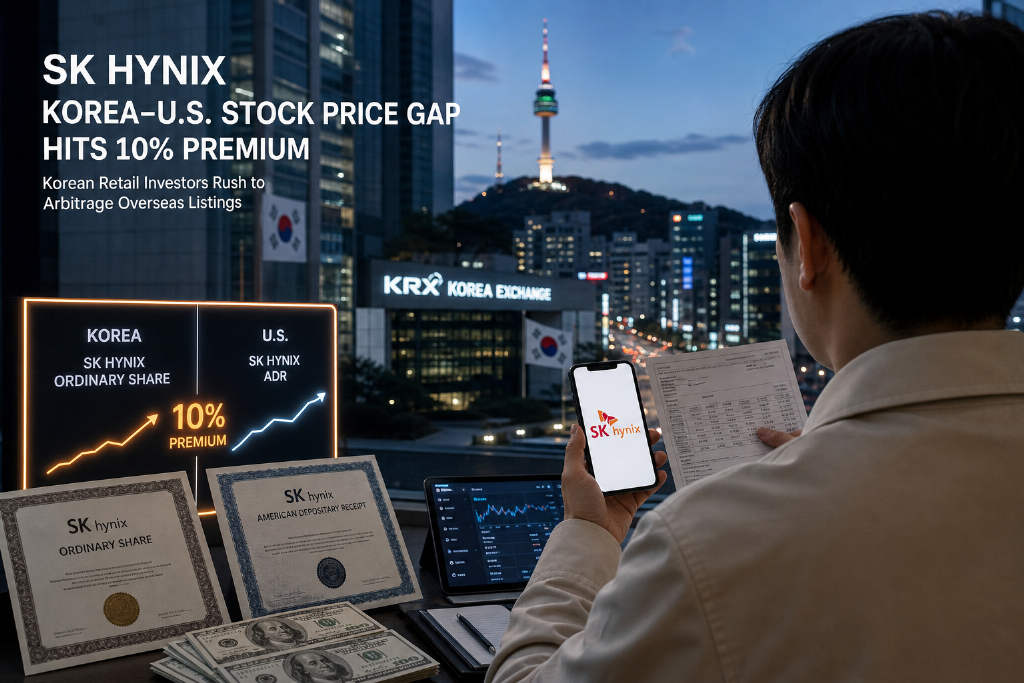
SK Hynix2026-08-18 12:35:59SK Hynix ADR Still Trades at a 10% Premium as Korean Retail Investors Poured $4.5 Billion Into U.S. Stocks in JulyKorean retail investors bought about $4.5 billion of U.S. stocks in July, according to the Korea Securities Depository, with roughly $840 million flowing into SK Hynix’s U.S.-listed ADR. That ADR is trading about 10% above the company’s shares in Korea, while financing balances on the Korean stock market fell from about 37 trillion won at the end of June to about 27 trillion won in early August. Acadian Asset Management executive vice president Owen Lamont said the price gap could be a sign of excessive speculation, even a symptom of a bubble. The shift into U.S. markets has not reduced risk-taking. AI, semiconductors and leveraged products remain the main bets, and four of the 10 most-purchased U.S. stocks in July were leveraged products, led by Direxion Daily Semiconductor Bull 3X Shares (SOXL). Analysts said Korean investors may simply be moving high-risk AI trades from the domestic market to the U.S. rather than exiting risk assets altogether. Industry participants also said Korea’s capital base is not large enough to move the broader U.S. market, but concentrated trading could still amplify swings in volatile names such as AI chips, quantum computing and leveraged ETFs.1190
US stocks2026-08-15 01:41:09August rally lifts Wall Street risk appetite, but cracks appear in the bullish setupU.S. equities rebounded sharply in August, with the S&P 500 rising about 4% month to date and briefly topping 7,800 for a fresh record, while the Nasdaq 100 moved back to within 2.5% of its June peak. The move has been fueled by a powerful second-quarter earnings season, cooler-than-expected inflation readings, softer retail sales, and a weaker U.S. dollar, all of which pushed traders to cut expectations for another Federal Reserve rate hike in September from 75% at the end of July to roughly 25%. Money has flowed back into technology shares and leveraged products. State Street custody data tracking more than $50 trillion in institutional assets showed demand for U.S. information technology stocks climbed to a five-year high over the past month. Bloomberg Intelligence data also showed leveraged index funds created nearly $50 billion in wealth this year, while single-stock leveraged funds lost about $4 billion. Still, the report points to growing tension across asset classes. Oil jumped about 6% this week, Brent crude approached $90 a barrel, and long-dated Treasury yields stayed elevated even as short-end rate expectations eased. Strategists at Deutsche Bank and Janus Henderson warned that markets are pricing a near-perfect mix of strong growth, limited tightening, and temporary supply shocks, leaving little room for error.1380